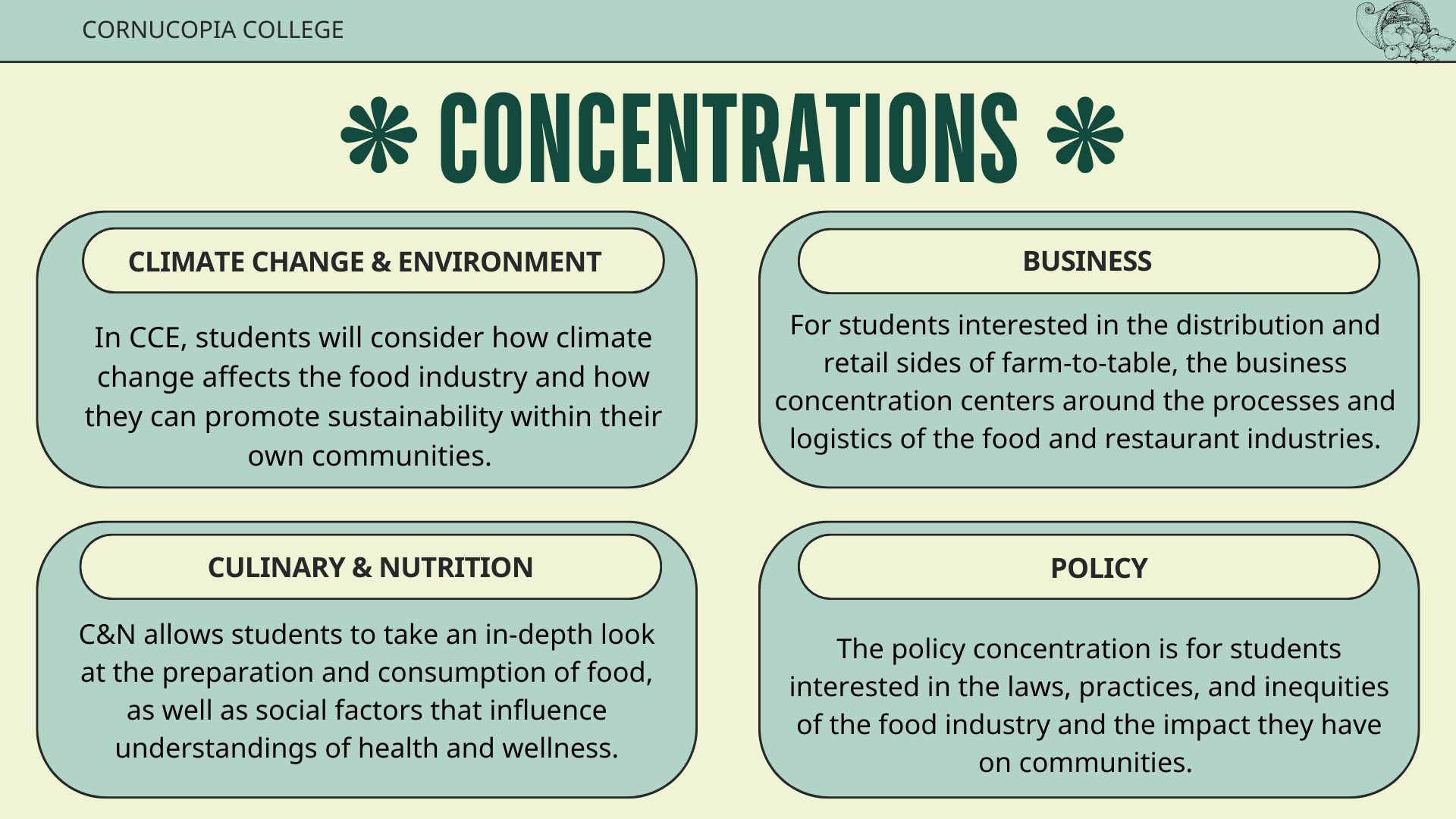
For this speculative design project, my team created Cornucopia College (CC), a three-year microcollege for students interested in agriculture, culinary arts, sustainability, food policy, and the food industry. CC’s core curriculum is based on the farm-to-table process, which ensures that students understand all aspects of the food system, preparing them for a wide range of careers in the food industry. After gaining exposure to every step of the farm-to-table process, students choose one part of the food industry to concentrate in. The four offered concentrations are Climate Change & Environment, Culinary & Nutrition, Business, and Policy.
speculative design
systems thinking
wicked problems

Inspired by David Staley’s Alternative Universities, our team was tasked with creating our own “alternative” post-secondary institution. After deciding on creating a microcollege based on the farm-to-table process, we developed three foundational principles: experiential learning, community-based learning, and human and planetary health.
In creating the core curriculum for the college, we decided on three components that were inclusive of the five steps of the farm-to-table process. Building on this foundation, we then created four concentrations for students to choose from: Climate Change & Environment, Culinary & Nutrition, Business, and Policy. The synthesis of the core curriculum and the concentrations is intended to create a comprehensive foundation and an opportunity for advanced specialization. We also created course offerings for all core requirements and concentrations.




Following the curriculum design, we identified expected costs and revenue for the Cornucopia College, based on average finances for existing institutions. We then identified opportunities for scalability, implementation, and limitations.
Foundational to CC’s academic experience is experiential learning. Aside from the more obvious applications in culinary and agricultural classes, students studying business and policy gain hands-on experience by using a variety of industry-related technologies, and by working with local restaurants, food vendors, and politicians to study their topics up close.
Through this project, we positioned climate change as a wicked problem and sought to create a holistic experience that prepares students to address climate change both locally and globally. To do so, we conducted a broad needs analysis of trends within higher education, and used it to inform CC’s principles and outcomes, curriculum design, pedagogical approaches, student experience, financial model, and scalability.